
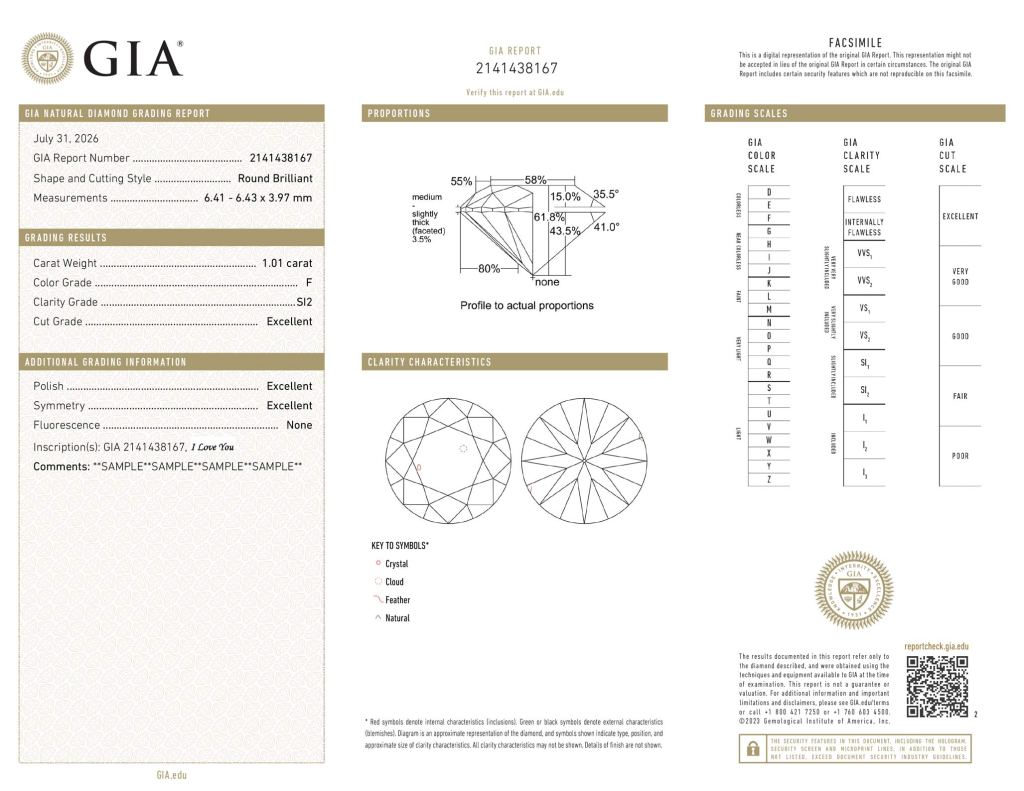
a diamond grading report reads like a tax form. four letters, a few decimals, a plotted diagram of flaws you may never see. it is also the single most useful document in the building, once you know which lines matter and which you can ignore.
here is the GIA system in plain language, and, more usefully, where your eye stops being able to tell the difference. there is a sweet spot and like all beautiful things of this natural world, no two are exactly the same, and therein lies the beauty!
who grades, and why GIA
the gemological institute of america (GIA) created the 4Cs grading system in the 1950s and remains the strictest, most consistent lab. a GIA report is a description of the stone, not an appraisal; it tells you what the diamond is, not what it costs. other labs exist and grade more loosely. when two stones look the same on paper and one is cheaper, check which lab wrote the paper.
the four Cs are color, clarity, cut, and carat weight. we will take them in that order because that is the order your eye reads them.
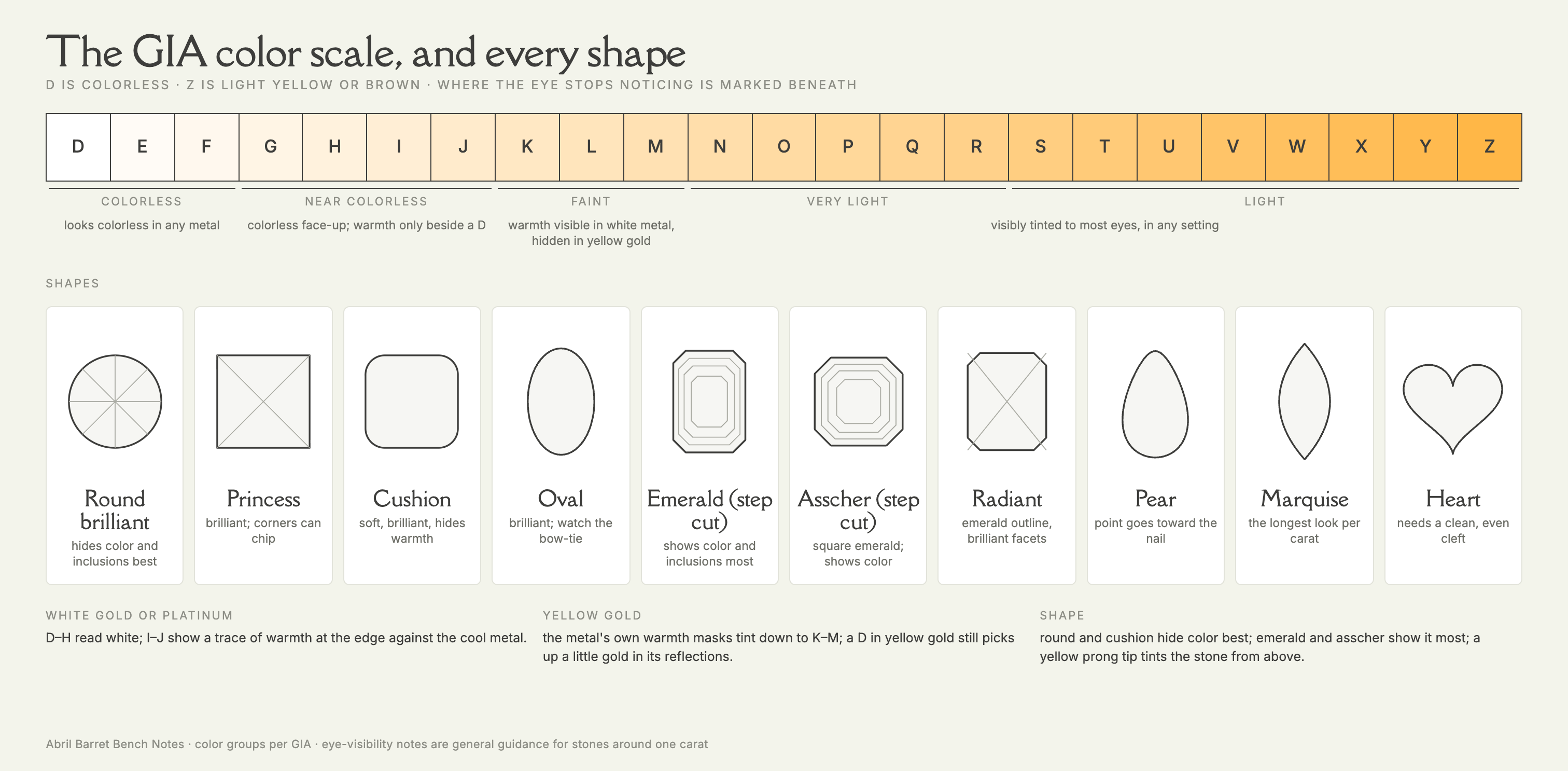
the color(less) scale: D to Z
GIA grades a diamond’s absence of color on a scale that starts, for historical reasons, at D and runs to Z. D is completely colorless; Z is light yellow or brown. (past Z, the stone becomes a “fancy color” and is graded on a different scale where more color is better.)
| grade | GIA group | what you see |
|---|---|---|
| D, E, F | colorless | icy white in any metal; differences between them are visible usually only to a grader or trained eye, loose, face-down, or against a master set |
| G, H, I, J | near colorless | colorless face-up to nearly everyone; warmth appears only side-by-side with a D–F stone |
| K, L, M | faint | a hint of warmth visible in white metal; but can disappear in yellow gold depending on the stone |
| N through R | very light | visibly warm to most eyes, in any metal |
| S through Z | light | obviously yellow or brown |
where the eye stops: a single color grade is not visible to the naked eye. two grades, rarely. most people cannot pick an F from an H when both are set. the cliff is around J to K in white metal and around M in yellow gold.
clarity: some flaws you will never find
clarity grades describe inclusions (inside) and blemishes (surface), judged under 10x magnification. the scale:
| grade | meaning | eye-visible? |
|---|---|---|
| FL | flawless, inside and out | no |
| IF | internally flawless | no |
| VVS1, VVS2 | very, very slightly included; hard to find even at 10x | no |
| VS1, VS2 | very slightly included; minor, found at 10x | VS1 no; VS2 usually no |
| SI1, SI2 | slightly included; easy to find at 10x | SI1 usually not but depends on the cut; SI2 sometimes, especially in step cuts and larger stones |
| I1, I2, I3 | included; visible at 10x, often to the eye | often |
where the eye stops: in a GIA graded stone VS2 and above are typically eye-clean. SI1 is eye-clean in most round brilliants. below that, it depends on the stone, which is why we look at the actual diamond and not the grade. a well-placed SI1 under a prong is invisible; a centered SI1 in an emerald cut is not.
what is actually in there. a GIA report plots each inclusion with a symbol and a key. the ones that turn up most:
| inclusion | what it is | what it means |
|---|---|---|
| crystal | a mineral trapped inside the diamond as it grew: another diamond, a garnet, a sulfide. colorless or dark. | a dark crystal is what the trade calls a carbon spot (it is usually not carbon). dark ones under the table are the easiest inclusions to see; colorless ones off to the side are usually harmless. |
| pinpoint | a crystal so small it reads as a dot at 10x. | alone, almost never visible. the usual reason a stone is VVS instead of IF. |
| cloud | a group of pinpoints too small to plot one by one. | small clouds are invisible. a large or dense cloud can make a stone look hazy or milky even at a good grade, which is why two SI1s can look different. |
| feather | a small break inside the stone; white and wispy at 10x. | most are harmless. one that reaches the surface, or sits at the girdle or a pointed corner (pear, marquise, princess), is a durability question; we check those before we set. |
| needle | a long, thin crystal, like a tiny rod. | usually invisible unless several run together. |
| twinning wisp | a ribbon of pinpoints, clouds and crystals along a plane where the crystal changed direction as it grew. | common in fancy shapes cut from twinned rough; usually fine, can read as a faint streak. |
| knot | a crystal that reaches the polished surface. | can show as a bump or a drag line in the polish; worth checking, and a bezel covers the edge anyway. |
| cavity | an opening in the surface where a crystal fell out during polishing. | collects dirt; one on the table matters more than one on the pavilion. |
| chip, bruise | a small break at the surface, usually at the girdle or a facet junction, from cutting or wear. | a chip at the girdle is the most common wear damage; a bezel or a well-placed prong covers and protects it. |
| indented natural | a piece of the rough crystal’s original surface dipping below the polish, usually at the girdle. | cosmetic; a sign the cutter saved weight. |
| graining | lines or streaks from irregular growth; colored, reflective or whitish. | faint graining is normal; heavy graining can look hazy. |
| laser drill hole | a tiny tunnel drilled to reach and bleach a dark crystal. | a treatment, not a flaw; GIA notes it on the report. it is the first thing we ask about. |
blemishes are on the surface only: polish lines, scratches, nicks, abrasion on facet edges, a natural (a bit of the rough’s skin left on the girdle), an extra facet. none of them change how the stone looks from across a table, and most can be polished out.
what matters more than the type is the position. under the table, centered, is where you see it; near the girdle, under a prong or a bezel wall, is where you don’t. the plot on the report tells you where; the stone in your hand tells you whether it matters.
cut: the one that makes it sparkle
cut is not shape. cut is how well the facets are proportioned, aligned, and polished, and it controls everything your eye reads as “sparkle”: brightness, fire (the rainbow flashes), and scintillation (the on-off pattern as the stone moves).
GIA assigns a cut grade (excellent, very good, good, fair, poor) to round brilliants only. for fancy shapes, the report lists polish and symmetry grades, and you judge the rest by looking… and feeling!!
where the eye stops: excellent and very good are hard to separate on the hand. good is visibly dimmer. this is the C to splurge on, because a poorly cut D flawless looks like glass and a beautifully cut H VS2 looks like a diamond.
carat: weight, not size
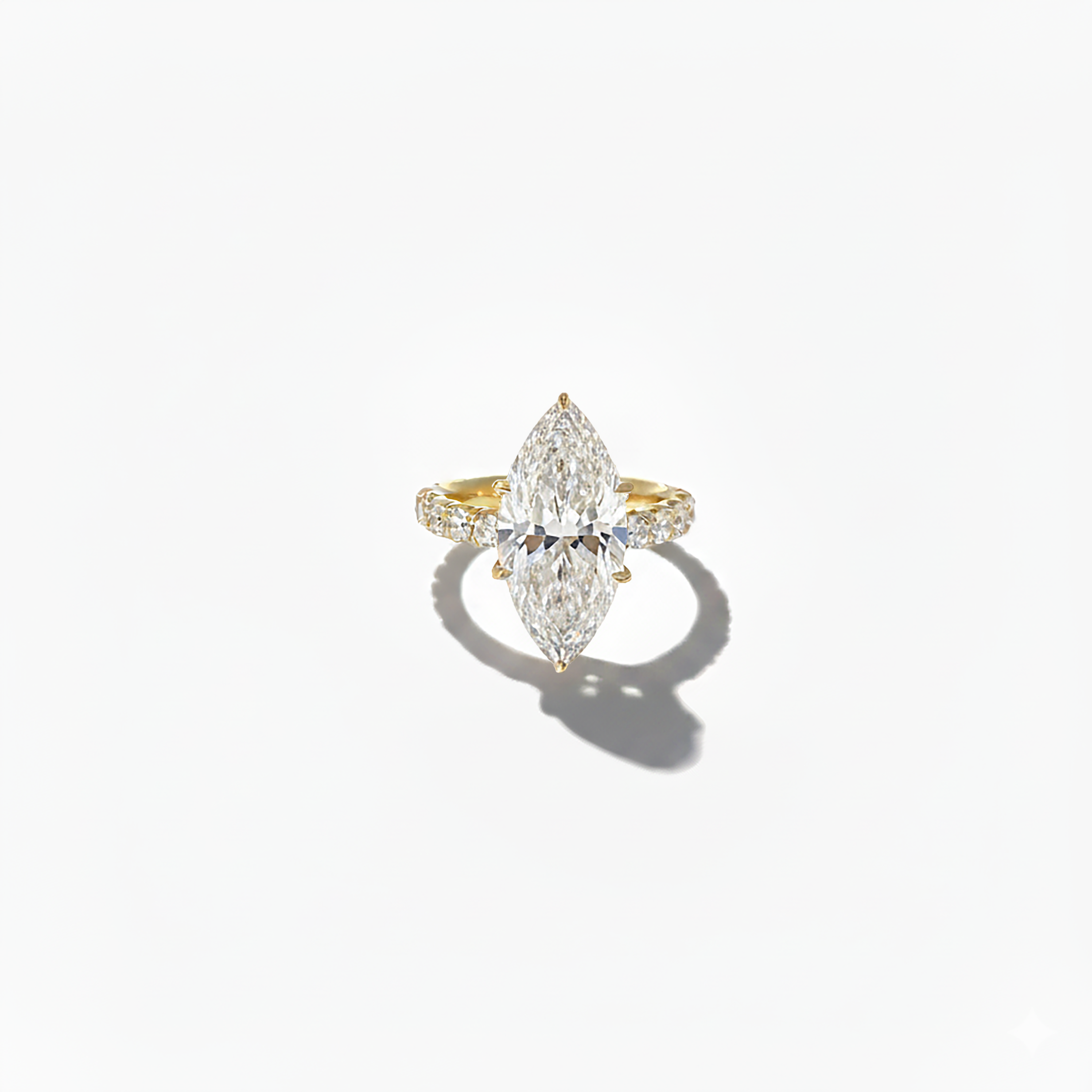
a carat is 0.2 grams. it is a weight, and two stones of the same weight can look different sizes depending on cut and shape. a deep-cut round hides weight underneath; a shallow oval or marquise spreads it across the stone.
where the eye stops: a 0.90 and a 1.00 carat look identical. the price does not, because of the “magic numbers” at 0.50, 1.00, 1.50, 2.00. buying just under a magic number is the oldest trick, and it still works.
every shape, and what each one does to color
shape is the outline of the stone, the perimeter shape. it is a preference, not a grade, but each shape handles color and clarity differently.
brilliant cuts (many small triangular facets) scatter light and hide warmth and inclusions:
- round brilliant — the best at hiding everything; the most expensive per carat because the most rough is lost
- oval — long, elegant, flatters a finger; look for a faint dark “bow-tie” across the middle and pick a stone where it is faint
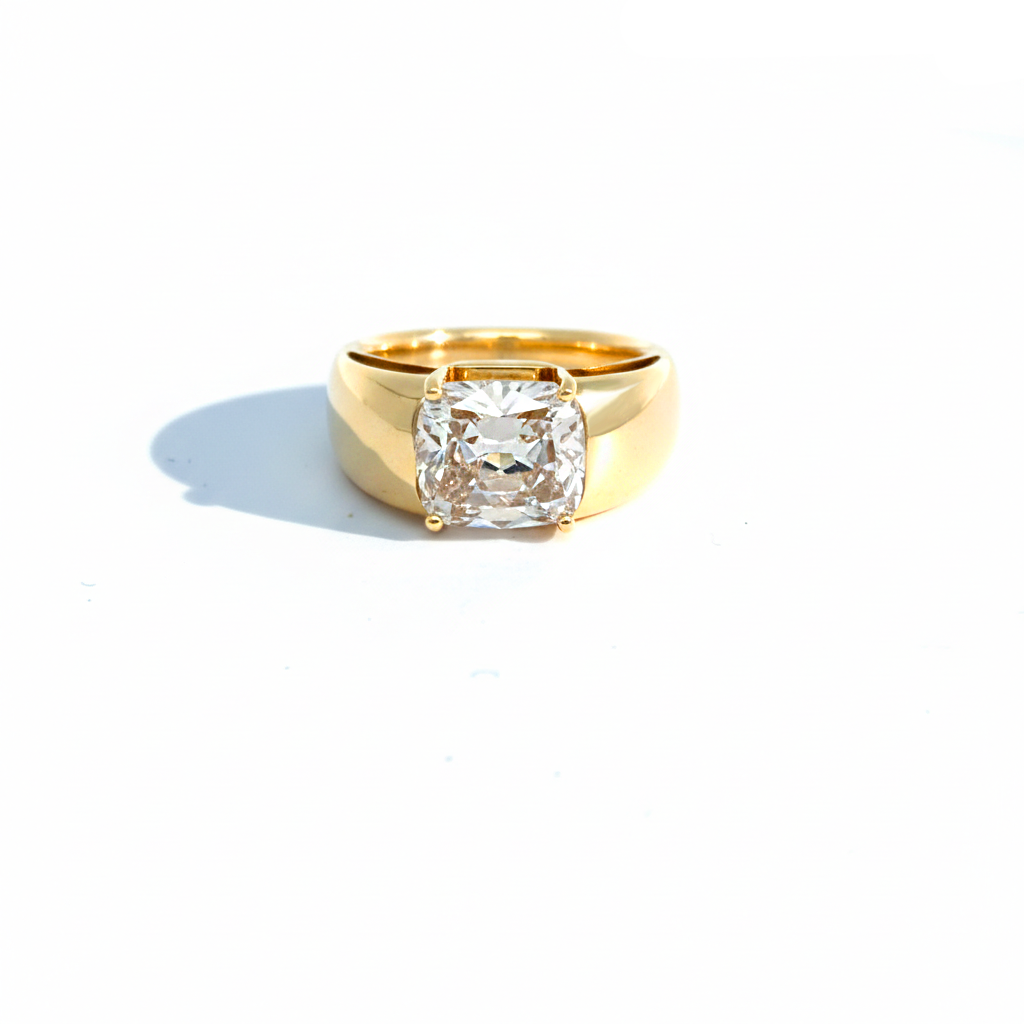
- cushion — pillow-soft corners, romantic, forgiving of color
- pear — a teardrop; worn point-toward-the-nail; the point needs protection
- marquise — a long lens; the largest look per carat; also bow-tie prone
- princess — a square brilliant; sharp corners that must be protected by prongs
- radiant — an emerald-cut outline with brilliant facets; the best of both for people who want sparkle in a rectangle
- heart — a pear with a cleft; needs excellent symmetry to read as a heart and not a strawberry
step cuts (long, parallel facets like a staircase) are calmer and more architectural, and they hide nothing:
- emerald — rectangular, hall-of-mirrors flashes; shows color and inclusions clearly, so go a grade or two higher in both
- asscher — a square emerald with a windmill pattern; same rules
there are also many shapes not mentioned here: movals, for example, are soft edged shape combining an oval and a marquise, theres also the beloved elongated cushion, very popular old mine cuts in nearly any shape, lozenges, and the list goes on.
what the metal does to the color
the setting changes what you see, it’s important to know your non-negotiables before embarking on a diamond hunt. if metal color is important, that will impact your diamond criteria.
white metal (white gold, platinum)
- reflects a cool white light into the stone, so any warmth in the diamond is shown rather than hidden
- a D–H stone looks icy; a J stone can read faintly warm; a K–M stone will look noticeably yellow against the white prongs
- best when the stone is G or above, or when you want a warm stone to look warmer
yellow gold
- reflects warm light into the stone; the eye recalibrates to the gold, and a faintly warm diamond reads as white by comparison
- a K, L, or M diamond in yellow gold can look colorless depending on the cut; a D in yellow gold looks like a D in yellow gold, which is to say the premium is mostly invisible
the prong trick. if you love yellow gold but want the whitest possible look, we can set the diamond in white-gold or platinum on a yellow band. the metal touching the stone is what the stone reflects. the reverse also works: a warm diamond in all-yellow prongs disappears into the band and looks like a single glowing thing.
this is the kind of decision we make at the bench, with the stone in a pair of tweezers against each metal. no chart replaces that. see it in person at the studio.
the short version
- buy cut first. excellent or very good.
- buy clarity down to VS2 without looking; SI1 with a look.
- buy color to match the metal: G–H for white, K–M for yellow.
- buy carat just under the magic numbers.
- ask which lab wrote the report.
- then forget all of it and pick the one that sings to you.
ready to make a 1/1 ring? that is bespoke. ask for our engagement ring portfolio.
lean into the fantastic.

